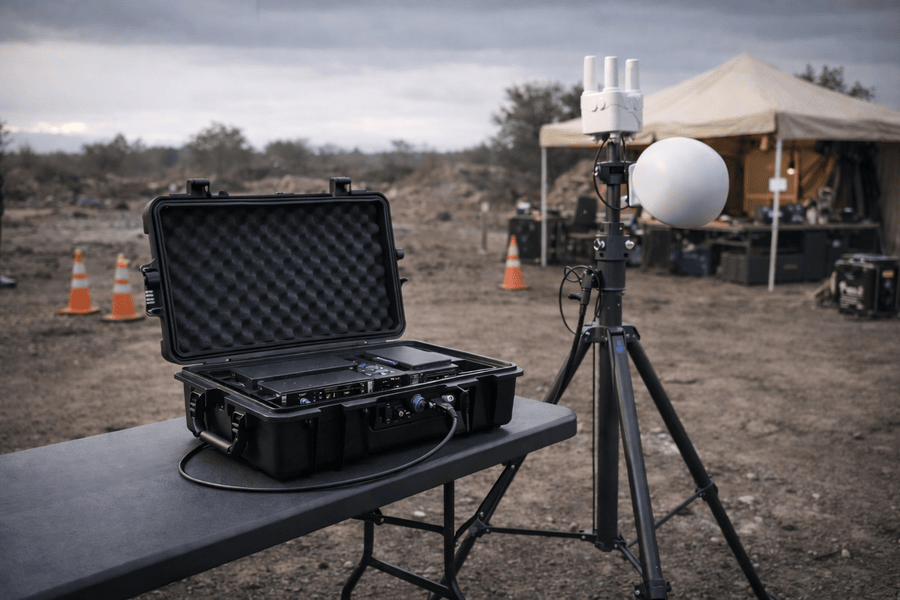
When disaster strikes — earthquake, flood, wildfire, or industrial accident — the communications infrastructure that normal operations depend on is often the first thing to fail. Cell towers lose power, fibre is cut, and the teams that most need to coordinate are left without connectivity. AINSORA's Deployable Connectivity Systems are built for this moment: self-powered, rapid-activation wireless nodes that establish a local network wherever they are placed, without relying on any fixed infrastructure to be intact.
The Crisis Communications Challenge
Emergency response operations face a connectivity problem that permanent infrastructure cannot solve:
- No time — response teams arrive before any fixed network can be restored or extended
- No power — grid failure is common in disaster zones; connectivity systems must be self-powered
- No fixed infrastructure — ground-level equipment may be physically inaccessible, damaged, or unsafe to approach
- Shifting geography — command posts, field hospitals, staging areas, and search sectors move as the response evolves
- Multiple agencies — police, fire, medical, and civil protection teams need connectivity simultaneously from the moment they arrive
What is needed is a system that a small team can carry to any location, activate without specialist tools or external power, and rely on through an entire operational shift.
AINSORA Deployable System Architecture
TacNet Case — Compact Command-Post Node
TacNet Case is a self-contained communications node integrated into a rugged wheeled case. It is designed to be the first network asset on site: transported to the command post, activated in under fifteen minutes, and immediately providing wireless coverage for the surrounding operation.
- Setup time — operational in under 15 minutes
- Local wireless coverage — integrated dual-band Wi-Fi serving up to 1,000 concurrent users within a 500 m radius
- WAN connectivity — WAN aggregation combining satellite and cellular uplinks
- Battery autonomy — up to 8 hours on the integrated battery
- Power options — AC mains, DC vehicle power, or internal battery
- Transport — wheeled airline-compliant case, under 18 kg complete
TacNet Case is suited to high-density locations that remain stable throughout the operation — the primary command post, a field hospital, or a major staging area.
TacNet Go — Mobile and Vehicle-Mounted Node
TacNet Go is an all-in-one system designed for maximum deployment flexibility: vehicle rooftop, tripod, or mast depending on the mission. It is built for teams that need connectivity to move with them — across patrol routes, through search sectors, or from site to site as the operation develops.
- Deployment time — operational in under 5 minutes in any mounting configuration
- Mounting options — vehicle roof, tripod, or mast
- Mobile operation — designed to maintain connectivity while the host vehicle is moving
- Local wireless access — integrated dual-band Wi-Fi 6 covering up to 200 concurrent users within a 500 m radius
- WAN connectivity — integrated satellite uplink plus cellular, with WAN aggregation for resilience
- Power — integrated battery-backed operation for off-grid and field use
TacNet Go suits mobile roles: forward reconnaissance, perimeter control, search-and-rescue sector coverage, and any function where the connectivity node needs to move as the team moves.
Example Response Scenario
The following illustrates how TacNet Case and TacNet Go combine in a coordinated response. Specific timings will vary by site, team, and conditions.
Phase 1 — Initial Arrival The first response team arrives with communications infrastructure down across the area. TacNet Case is positioned at the designated command post. Within fifteen minutes, local Wi-Fi coverage is active and WAN connectivity is being established through the satellite uplink.
Phase 2 — Forward Coverage A field team moves toward the affected area with TacNet Go mounted on their vehicle. The unit activates en route and provides local wireless coverage at the forward position upon arrival, maintaining a WAN connection independently of the command-post node.
Phase 3 — Expansion As the response scales — additional agencies arrive, sector boundaries expand, a field hospital is established — additional TacNet units are deployed to each new concentration point. Each operates independently with its own WAN uplink and local coverage area.
Civil and Public-Safety Use Cases
Natural Disaster Response
Earthquakes, floods, and wildfires commonly destroy fixed telecommunications infrastructure across wide areas simultaneously. TacNet units provide the network layer that allows multiple response agencies to coordinate from the moment of arrival — before any commercial restoration effort is possible.
Industrial Accident and Hazmat Response
Industrial site emergencies require reliable communications between perimeter control, decontamination areas, medical triage, and the incident command post. TacNet Case provides a stable command-post node; TacNet Go extends coverage to mobile response teams operating across the site.
Planned Events with Contingency Requirements
Public events — major sporting events, political summits, large outdoor gatherings — need contingency communications infrastructure that can activate if commercial network capacity is overwhelmed or fails. TacNet units can be pre-positioned and brought online within minutes.
Remote Operations Without Fixed Infrastructure
Construction sites, offshore platforms, and remote industrial facilities that temporarily lose their primary communications link use TacNet units to maintain operational connectivity until the primary link is restored.
Request a Deployment Consultation
AINSORA's deployable systems team works with civil protection agencies, emergency management organisations, and system integrators to match a deployment architecture to specific response profiles and operational requirements.
- Request a consultation — info@ainsora.com
- Talk to our solutions team — describe your operational scenario, team size, and coverage requirements